Showing posts with label coniston. Show all posts

Tarn Hows

Tarn Hows, which is a man made lake, was developed from three smaller tarns - which were known as High Tarn, Low Tarn and Middle Tarn. The stream, which joined these tarns, was dammed during the 19th century to create the present lake. In 1929 Beatrix Potter bought the Monk Coniston Estate which included this tarn and she sold half the tarn to the National Trust and bequeathed the other half to them in her will.


The circuit of the tarn is one of the most popular walks in The Lakes so an early arrival is essential to get a car parking space. For more adventurous walkers, at the top end of the tan, a footpath leads up to the summit of Black Crag. The extension is worth it for the views to The Scafells alone. 


I just stayed on the top path which leads from a small disabled car park to a National Trust Property called Rose Cottage and possibly gives better views than the lower tourist path. It certainly give a better view of the surrounding hills. The path after that deteriorates and is quite muddy but if you do carry on it, it will eventually lead you downhill to join the main path around the tarn.


Refreshments were had in Coniston where there are numerous cafes and pubs, I settled for a coffee in Herdwicks Cafe which is next to The Ruskin Museum which covers the history of the town since 1901.  I think it may be a new cafe as I don't recall seeing it the last time I visited.


A lovely walk which was well worth the journey.


Rose Cottage Path

Tarn Hows from Rose Cottage path

Wetherlam

Tarn Hows from Rose Cottage path

Tarn Hows from Rose Cottage path

Rose Cottage Path

Wetherlam

Tarn Hows from Rose Cottage path

Tarn Hows from Rose Cottage path

Tarn Hows from Rose Cottage path

Tarn Hows from Rose Cottage path

Tarn Hows from Rose Cottage path

Tarn Hows from Rose Cottage path

Rose Cottage Path

Rose Cottage Path

Rose Cottage Path


Little Langdale and Hodge Close

Pretty it is not but there is so much to see and explore. Hodge Close and the Tilberthwaite quarries are really joined at the hip so you could park in either area and explore both. The Coniston mines are just a few more miles down the road. Add Cathedral Cave in to your day and you have a magical insight in to the history of mining and quarrying in the Lake District. There are other areas like Honister, Greenside Mines in Glenridding and the Back of Skiddaw which have their fair share of workings but none on this scale.

The quarries have been mostly idle for decades and nature has pretty much reclaimed them; blanketing them in deciduous woodland. The actual quarries are of most interest to rock climbers and divers, however there is a legacy of tracks and bridleway associated with them that connect with the main valleys of Yewdale and Little Langdale, so there are walks aplenty.

It is likely that slate has been worked and used in Cumbria since man first appeared here in prehistoric times. It certainly has a long history. There is evidence of its use from the time of the Romans at their fort at Hardknott above Eskdale.

Slate was originally won by hand, with gunpowder introduced from 1800 and compressed air drills from 1910. Diamond tipped saws replaced the cutting of blocks by hammer and chisel from the 1930’s. Various methods of moving the rock around were developed including inclines – both external as at Yew Crag, and internal as at Honister – and aerial ropeways, as at Hodge Close and Coniston Old Man.

In their working arrangements the quarries were primitive in the extreme, with no provision for the comfort of the quarrymen and very little for their safety. Until later times it was a labour-intensive industry. The large pieces thrown down by a blast were themselves bored and blasted until reduced to manageable proportions after which further hard work, with the aid of sledgehammers and wedges, was required to produce pieces which could be carried away to the riving shed. Here the river split the stone into thin sheets, and the dresser shaped them into slates with a special heavy knife. It was a dangerous occupation, even for someone at the end of the process. The industry today is only a fraction of its size at the turn of the century but still active with a number of smaller operations on both sides of the Tilberthwaite Valley.

Yew Tree Tarn

Yew Tree Tarn

Hodge Close

Hodge Close

Hodge Close

Hodge Close

Hodge Close

Holme Fell

Holme Fell

Holme Fell

Holme Fell

Holme Fell

Holme Fell

Holme Fell


Holme Fell

It must have been twentry years since I was last on Holme Fell when I was helping a friend do the Wainwrights. I've been to Hodge Close a fair few times but have always walked down into Little Lnagdale and not up Holme Fell.

I really have missed so much. It must be one of the most beautiful fells in The Lakes; not very high but a pure joy to walk upon. There has been a lot of quarrying in the past so there are a few disused dams scattered about and the remnants of many disused quarries but these just add to the beauty of the place. Nature has done a superb job and created beauty which ever direction you look.

The views from up high are first class as well; to the west you can see some of the Coniston Fells and to the north west are The Langdale Fells. Eastwards Windermere can be seen and on a clear day, you can see right across to The Yorkshire Dales.

I didn't quite make it to the top but I'm presuming that from the summit, you can see Coniston Water and right down to Morecambe Bay.

Due to my health issues, I knew when I had reached my limit, so I just found a large boulder to plonk my behind on, sat for a while and picked another of the many paths scattering the fell to walk back down to Hodge Close and my car.

Without doubt I will be returning, as my walk on Holme Fell was one of the most enjoyable I have done for many a year. 

Hodge Close Quarry

Quarry Path, Hodge Close

Quarry Path, Hodge Close

Quarry Path, Hodge Close

Quarry Path, Hodge Close

Disused Dam, Holme Fell

Disused Dam, Holme Fell

Disused Dam, Holme Fell

Disused Dam, Holme Fell

Looking towards Wetherlam

Disused Dam, Holme Fell

Holme Fell

Holme Fell

Langdale Pikes

Holme Fell

Holme Fell

Holme Fell

Disused Dam, Holme Fell


The Langdale Valley and Holme Fell


This must have been the third time this year when I have visited Langdale in the vain hope of getting parked up. Mind you, I should have known better than paying a visit of a crisp, sunny Sunday. I did manage to pull off the road at one spot to take some photos but I was blocking a farmer's field so quickly took a few snaps and moved on. Both National Trust car parks were full as well so, as the valley was running out, I found myself heading up the road leading across to Little Langdale and Wrynose Pass with the hope of getting a parking spot in the Blea Tarn car park but luck wasn't on my side there either. At this point I had more or less resigned myself to being stuck in the car all afternoon!

Also the drive along Little Langdale was a nightmare due to inconsiderate parking and sheer volume of traffic. So, as a last resort I tried the side road leading up to Hodge Close Quarry and lo and behold there were a couple of parking spots in the pull of area near Shepherd's Bridge.

With sheer relief, I donned my walking shoes and headed off on a path which said Yew Tree Farm. I'd never been on it before and it was a sheer delight to walk on. Part way along I came across a couple out with their dogs who told me of a path which turned off just before the farm and led in to Yewdale and eventually Holme fell.

Up for a bit of an explore, I took this path and was rewarded by a beautifully peaceful walk going through both woodland and rocky scenery. They mentioned that it was a sharp scramble to get up on to Holme Fell so, as the path began to steepen and the light began to fade, I turned round and retraced my footsteps back.

I think it was about three when I got back to the car but even at that time of day, the sun had dipped below the fells. Days are very short at this time of year in The Lakes and a lot of people on the higher fells are caught out by this. A group of ten people had to be rescued off of Scafell Pike the other week after running out of daylight, mainly because the idiots hadn't set off until half past two!! The Mountain Rescue are always polite when discussing their rescues but it would have been nice to be a fly on the wall at one of their debriefs when something like that happens.

After consulting a map once I'd got back, I found that my path was part of a network linking Coniston to Skelwith and Elterwater . It's an area I will bear in mind in future although I cant see me ever using it to get up Holme Fell as there are easier and more scenic paths up from both Hodge Close and Tilberthwaite.

All in all I was just pleased that I had managed to get out of the car for a stroll and visiting a new area was an added bonus.
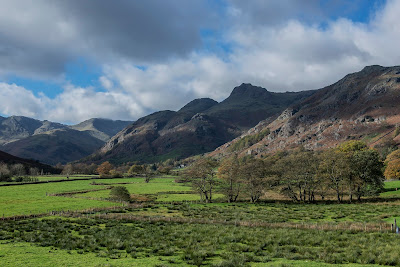

Great Langdale

Langdale Farmstead

Langdale Farmstead

Contrast in light, langdale

Langdale Pikes


Shepherd's Bridge, Yewdale

Water under Shepherd's Bridge

High Yewdale

High Yewdale

Raven Crag

High Yewdale

Raven Crag

Harry Guards Wood, Yewdale

Harry Guards Wood, Yewdale

Harry Guards Wood, Yewdale

High Yewdale

High Yewdale

Tarn Hows

Tarn Hows, which is a man made lake, was developed from three smaller tarns - which were known as High Tarn, Low Tarn and Middle Tarn. The s...