Showing posts with label Dunster castle. Show all posts

Dunster and England's Tallest Tree

We went to Dunster the last time we were in Somerset but mainly spent our time exploring the castle and its gardens. This wasn't an option this time as the gardens were open but the castle was closed to visitors. Instead, we had a more detailed look around the old medieval town and discovered a couple of its hidden gems.

First things first though. Before any sort of exploration is commenced, a good strong coffee is needed and this was provided by Tessa's Tea Shop situated on the High Street. As all the tables were outside, it was the perfect place to just sit, relax and watch the world go by, something that I think a lot of people have missed this past year.

We then had wander along the High Street looking at all the interesting shops, many of which sold local produce. One of the things which caught our eye was Whortleberry Jam, but the romance of the name disappeared when it we found out that whortleberry is just a local name for bilberry or bleaberry.

Sal wanted to visit an old packhorse bridge called Gallox Bridge so we headed through the town in search of it. On our way we came across a local community garden which had been designed as a quiet place to give both locals and tourists a means of escaping the hustle and bustle of the busy town centre. Dunster can get a bit hectic as one of the few major roads of the area going directly through it. We spent a fair amount of time in there, photographing the many flowers the locals had planted and just enjoying the peace and quiet.

And so on to Gallox Bridge. In the Middle Ages Dunster flourished as a market and port for wool, with fleeces being brought down from the moors to be sold there. Many of them were carried by packhorse across the river Avill via Gallox Bridge, which was the main route into Dunster from the south. 

It is referred to as Gallox Bridge in a variety of spellings such as Gallocksbrigge, Gallox Bridge or Gallocks Bridge. The name derives from the gallows that stood on a hill outside the town which were a symbol of the authority of the lords of Dunster Castle, who had the right to try and hang any thief caught within the area of their jurisdiction.

Alongside the bridge was an ancient ford – probably older than the bridge – for wheeled traffic. The bridge and ford functioned together: pedestrians and packhorses (with their wool fleeces) using the bridge, and carts driving through the ford. This area must be the oldest part of the town and it is still surrounded by beautiful thatched cottages. 

It was then a pleasant stroll back through the village to the pasty shop where we bought a couple for our lunches.

A few days earlier we had been diverted on to a side road when we were heading for The Royal Oak in Luxborough. On this back road there was a signpost for 'The Tallest Tree in England' so, as it was only a few miles down the road, we decided today was the day to investigate.

It was a Douglas Fir tree and was situated in a woodland called Nutcombe Bottom. In 2009, the Guinness Book of Records recorded it as being 198ft high, weighing 50 tonnes and having a diameter of 6ft. It was certainly an impressive size.

We finished our day off  having lunch in one of the forest clearings, with great views of Exmoor on one side of us and The Bristol Channel on the other. The only thing missing was mushy peas with a dash of Hendo's!

The Yarn Market

Dunster Main Street

Dunster Main Street

Ironmongers, Dunster Main Street

Cafe, Dunster Main Street

Refreshments

Dunster Main Street

Dunster Main Street

Dunster Main Street

Dunster Main Street

Wobbly Window, Dunster Main Street

Dunster Community Garden

Dunster Community Garden

Dunster Community Garden

Priory Church of St George

Postbox Freak

Thatched Cottage, Dunster

Thatched Cottage, Dunster

Gallox Bridge, Dunster

Priory Church of St George

Tallest tree in England, Nutcombe Bottom

 
Tallest tree in England, Nutcombe Bottom

Somerset Holiday - Selworthy and Dunster Castle


Just two places to visit today and they were both on Sal's "to do" list. Our first port of call was a very quaint old village called Selworthy which was owned by The National Trust and reached via a narrow country lane leading off the A39. The name of the village means "enclosure or settlement near sallows or willows" and is recorded in The Doomsday Book. 

Selworthy was rebuilt in 1828 by Sir Thomas Acland as a model village to provide housing for the aged and infirm of the Holnicote estate. One of the cottages houses Periwinkle Tearoom where we both had a coffee and shared a slice of their delicious carrot cake. It really is a must for any visitor as the tearoom garden gives a great view over the cottage roofs to a distant Exmoor. Once we were fed and watered Sal paid her obligatory visit to the gift shop where she bought a couple of mementos.

Many of the other cottages, whose walls were painted with lime wash that had been tinted creamy yellow with ochre, are now rented out and are still thatched and obviously listed. The village and the surrounding Holnicote estate was given to the National Trust in 1944 by Sir Richard Acland, having been passed down through the Acland family for nearly 200 years and the whole area is immaculately maintained by them. It really did feel like we had been transported back to a by-gone era.

Before heading off, we popped into All Saints Church which dates right back to the 15th-century and, because it is perched on the side of a hill, its porch gives a superb view out across the valley to Dunkery Beacon which is the highest point of Exmoor.

We eventually dragged ourselves away and headed a few miles down the road to Dunster and it's Castle. Things didn't start too well with parking problems which I wont go in to here, but after  winning the 'man over car technology battle' we headed off for an explore of the town and Castle. It calls itself a village and claims to be "the largest and most intact medieval village in England" and from what I saw, I don't think they are far wrong with that. 

Seemingly it has a wealth of history to discover, including the Castle, the octagonal Yarn Market (which goes back to Dunster's once thriving cloth-trade), the remains of a Benedictine priory, a Working Watermill, Packhorse Bridge and Iron Age settlements. We went to the watermill for coffee, looked at the priory from the pub beer garden and saw the Yarn Market but missed out on the settlements and packhorse bridge which is a shame because it looks rather pretty. 

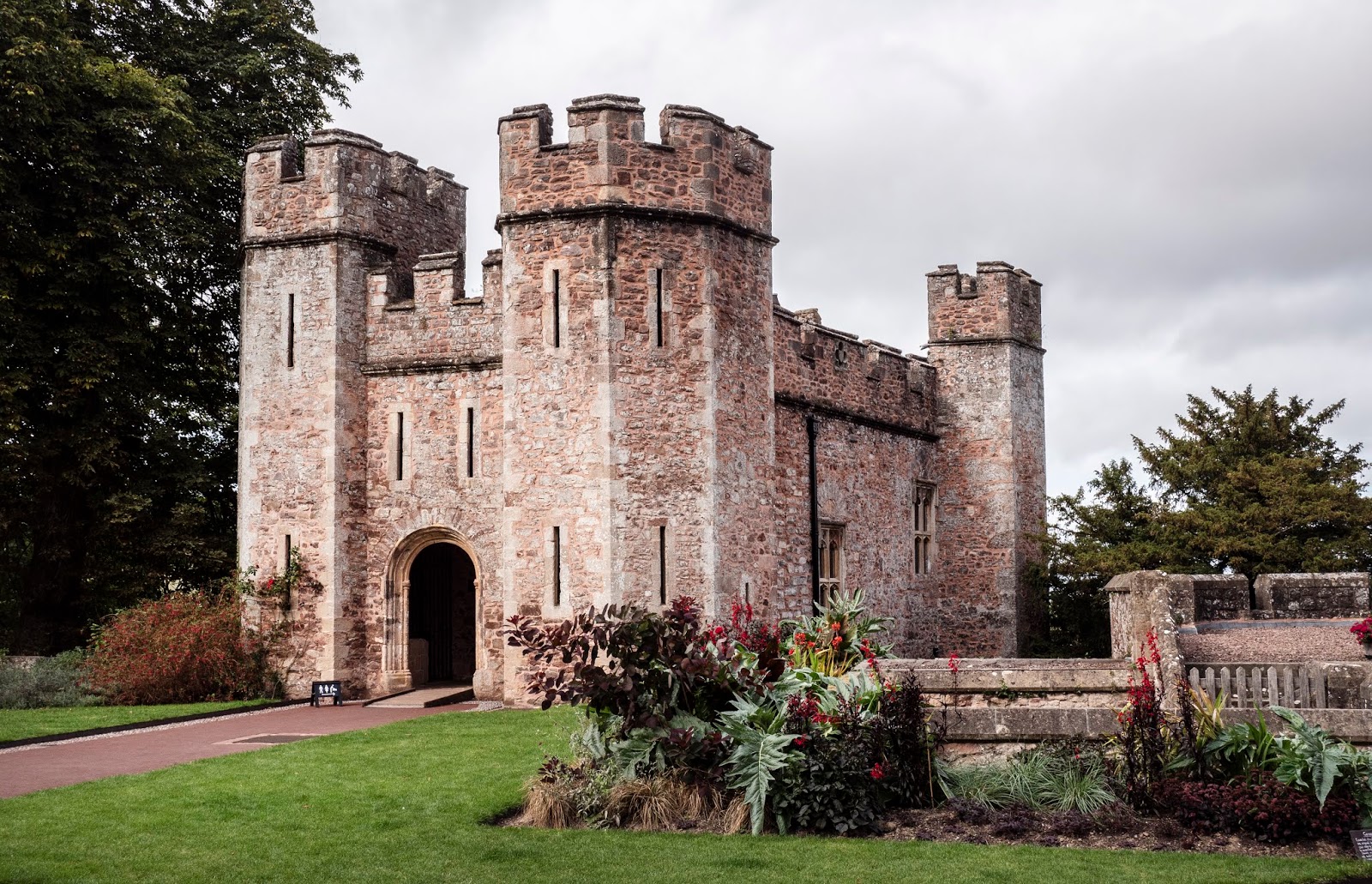
We did more than could be expect of us on the castle front as we made two trips there, one either side of a snifter in The Dunster Castle Hotel. The Castle was pretty much complete and had very attractive gardens but, at the end of the day,  a castle is a castle to me and they all look the bloody same inside. Dunster Castle's saving grace was a 1940's loo and kitchen built slap bang in the middle of all its other ancient history which raised eyebrows and a smile. I've posted a photo of the loo at the end of the blog.

Another thing to note was the Security at the Castle entrance. This consisted of a mouse which had become so used to visitors that it unashamedly sat outside the ticket office tucking into the grub which someone had put down for it. If I'm being honest, apart from Periwinkle Tearooms, the mouse was the visitor attraction of the day! Sal then did one of her disappearing acts which I've gotten used to now. She found another quaint section of the town which we penned in to visit on our next trip there.

We then wearily headed back to the car and made our way back to base. After a few hours rest and some food, we walked down to Watchet harbour and then enjoyed a couple of pints of cider each in Pebbles Tavern. A smashing way to end a long and tiring day.

Dunkery Beacon from All Saint's Church

All Saint's Church Selworthy

Selworthy Thatched House

Selworthy Village Green

Selworthy Village Green

Periwinkle Tearooms

Selworthy Thatched Cottage

Selworthy Thatched Cottage

Selworthy Thatched Cottage

Coffee Time

Sal taking photos

Selworthy Thatched Cottage

View over Selworthy Village

View over Selworthy Village

Dunster Main Street
 
Dunster Main Street
Dunster Castle Gardens

Dunster Watermill

Hilltop Folly, Dunster

Conservatory, Dunster Castle

Dunster Castle Gardens

Gatehouse. Dunster Castle

Dunster Castle

Castle Entrance

Dunster Castle

Dunster from The Castle

Local Mouse

Sal at Castle Entrance
Toilet, Dunster Castle

Pebbles Tavern, Watchet

Pebbles Tavern, Watchet


Tarn Hows

Tarn Hows, which is a man made lake, was developed from three smaller tarns - which were known as High Tarn, Low Tarn and Middle Tarn. The s...